
By KBP | Homeowner, Independence at Mather
Let me be direct: I am not writing this because I am angry about $64.
I am writing this because what happened to me when I tried to exercise a basic legal right as a homeowner is something every one of our neighbors deserves to know about — especially those who have been told that people raising concerns about the Board are wrong, misinformed, or stirring up trouble.
I have the receipts. Literally.
The Meeting
On April 28, 2026, the Board held an HOA meeting where they discussed and voted on insurance-related matters tied to a significant premium increase. When homeowners in attendance asked whether they could review the supporting documents behind that decision, the answer from management was essentially: yes, request them.
So I did.
That same night, I submitted a written request for the Association’s insurance records — current fiscal year and the prior two fiscal years. I specifically asked for electronic delivery: email, secure link, or another digital method. I explicitly stated that paper copies should not be mailed unless the Association confirmed no electronic version existed.
That request was reasonable. It was also my legal right.
What California Law Actually Says
Before I tell you what happened next, you need to know what the law says — because the Board is counting on you not knowing.
California Civil Code §5205 gives every homeowner in an HOA the right to inspect and receive copies of association records. This includes financial records, insurance documents, meeting minutes, and more.
Here is what the law specifically allows associations to charge:
- Actual copying costs for standard association records
- Redaction costs (up to $10/hour) — but only for “enhanced association records” that contain confidential information requiring redaction (things like executive session minutes or personnel files)
- Actual mailing costs — but only if mailing is actually necessary
Here is what the law does not allow:
- Charging “production fees” as a separate, undefined category
- Forcing paper delivery on records that exist digitally and require no redaction
- Treating standard insurance documents as “enhanced records” to justify higher fees
- Conditioning the start of the legal compliance timeline on payment clearing first
That last point matters. The law says the Association has 10 days to make current fiscal year records available after receiving a request — 30 days for prior fiscal years. The clock starts when they receive your request. Not when they receive your money.
What Actually Happened
Instead of a digital file, I received Invoice #112, dated May 1, 2026, for $64.69.
The charges broke down as follows:
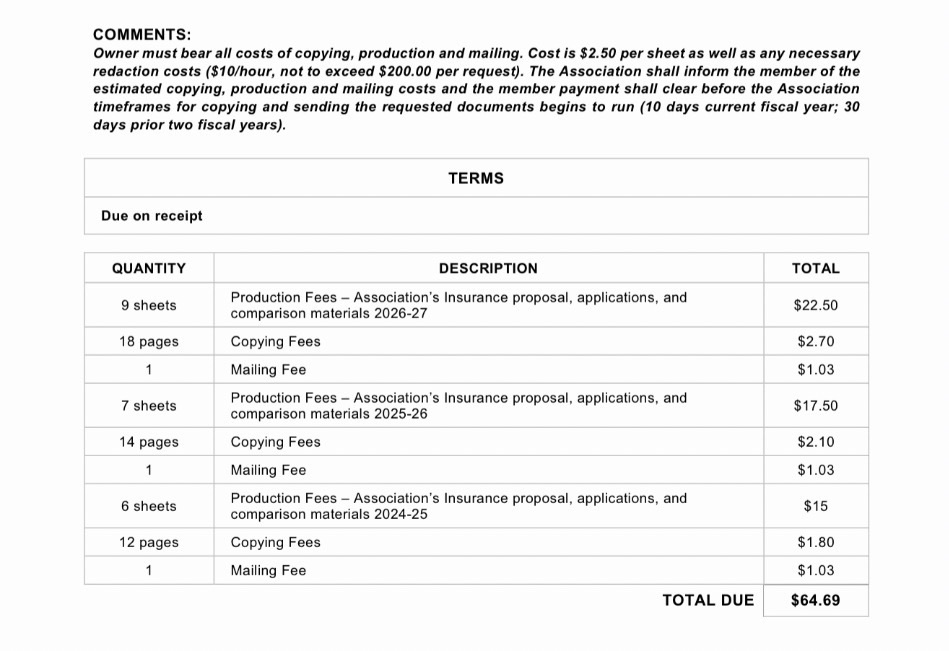
Look at that table carefully. There are three separate charges stacked on top of each other for every single fiscal year: a “Production Fee,” a Copying Fee, and a Mailing Fee. Let’s take them one at a time.
The “Production Fee” is $2.50 per sheet — and that number has no basis in the statute.
Civil Code §5205 authorizes charges for the direct and actual cost of copying. That means whatever it actually costs to make a copy — not a flat markup, not a service fee, not a round number pulled from a fee schedule. If the Association is charging $2.50 per sheet as a “production fee,” they are required to be able to answer four questions:
- What service does that fee actually cover?
- Why is that service necessary for these documents?
- Why does $2.50 reflect the direct and actual cost — not a markup?
- Where in Civil Code §5205 is that charge authorized.
The Copying Fee appears to be charged on top of the Production Fee — which raises an obvious question.
If “production” already covers the act of producing copies, what is the separate copying fee for? The statute does not authorize both. If production is copying, one of those charges is duplicative. If production is something else, the Association needs to explain what — and why it costs $2.50 a sheet.
The Mailing Fee was charged even though I never asked to be mailed anything.
I explicitly requested electronic delivery. Mailing fees are only a legitimate charge when mailing is actually necessary. It is not necessary when the homeowner has requested electronic delivery and the documents require no redaction.
The invoice stated: “Owner must bear all costs of copying, production and mailing… The Association shall inform the member of the estimated copying, production and mailing costs and the member payment shall clear before the Association timeframes for copying and sending the requested documents begins to run.”
That final clause — payment must clear before their legal clock starts — is not in the statute. I checked. It does not exist.
I asked management what software or method was being used for redactions, since that might explain the “production” line items. I received no substantive answer until our assigned manager’s supervisor stepped in.
The Supervisor produced every single requested document electronically — zipped and emailed — and confirmed there was no redaction because there was no confidential information in any of the documents.
So let me ask the obvious question out loud:
If these records required no redaction, existed digitally, and could be emailed in minutes — why was an invoice for $64.69 issued when I made my request?
Why This Matters Beyond $64
Here is what I believe is happening, and I want to be clear that this is my opinion based on what I have personally experienced and documented:
The Board and management are using procedural friction to discourage homeowner participation.
Not through any single dramatic action. Through accumulation. Through invoices that arrive before anyone answers your questions. Through “not on the agenda” rulings that block homeowners who have been trying to speak for months. Through fee structures that cite the law selectively while quietly adding conditions the law does not actually require.
It works because most people — understandably — decide it is not worth the fight.
I am telling you it is worth the fight. And more importantly, I am telling you that you do not have to fight blind.
Your Rights as a Homeowner
Here is what you are entitled to under California law:
You can request records. Civil Code §5205 gives you the right to inspect a broad range of association records, including financial documents, insurance policies, meeting minutes, and contracts.
You can request electronic delivery. If the records can be transmitted electronically in a noneditable format, the Association shall provide them that way upon request. “Shall” is not optional.
You cannot be charged for redaction on standard records. Redaction fees only apply to enhanced association records — documents that actually contain confidential information. Standard insurance proposals, applications, and comparison materials are not enhanced records.
The clock starts when they receive your request. Not when they receive payment. The 10-day / 30-day statutory timeline is triggered by receipt of your written request.
You can dispute improper charges. If you are invoiced for fees that have no basis in Civil Code §5205, you are not legally obligated to pay them. You can — and should — put that dispute in writing.
To My Neighbors Who Were Told We Are Wrong
I understand why some of you believe the Board’s characterization of people like me. HOAs depend on homeowners trusting that management has everything under control, that the people raising questions are just difficult, that everything is fine.
I am asking you to look at the invoice.
I am asking you to read the statute — it is publicly available, free, and not complicated.
I am asking you to consider: if everything was above board, why did it take a supervisor’s intervention to produce documents electronically that were initially invoiced for paper delivery at $64.69?
I am happy to pay what is legally owed. I will dispute what is not. And I am writing this because you deserve to make an informed decision about your own community — not one made for you by people who benefit from your disengagement.
What You Can Do
- Attend meetings. Dates are posted on the Association’s website. Your presence matters.
- Submit written records requests. Always request electronic delivery in writing. Keep a copy.
- Know your rights. California Civil Code §5205 and §5200 are your starting points.
- Ask questions publicly. At meetings, in writing, and in this community.
- Connect with neighbors. This is not one person’s issue. It affects every homeowner’s dues, governance, and property values. And be skeptical of narratives that turn engaged homeowners against each other. When neighbors who are asking legitimate questions get blamed for the conflict rather than those who created the conditions for it, we end up fighting amongst ourselves — which is exactly what makes it easier for the real problems to go unexamined..
Transparency should not be a privilege reserved for those who push back hard enough to reach a supervisor.
KBP is a homeowner at Independence at Mather. The views expressed here are her own and are based on documented personal experience. Nothing in this post constitutes legal advice. Homeowners with specific legal questions are encouraged to consult a California HOA attorney.
California Civil Code §5200 — Definition of association records California Civil Code §5205 — Right to inspect and copy records California Civil Code §5210 — Penalty for willful failure to provide records


Leave a Reply