
An HOA budget tells homeowners what the Association plans to spend. A vendor contract tells the Association what it has agreed to pay.
Those are not necessarily the same thing.
The difference matters at Independence at Mather because the Association’s 2026 budget was approved using vendor-related expenses for FirstService Residential and Bianco, while FirstService Residential later confirmed in writing that no additional amendments to either vendor contract existed and that the agreements previously provided in April 2025 remained the “most current and active agreements.”
So the question is not whether the Board approved a budget.
It did.
The question is whether approving a number in a budget is enough to change what the Association is contractually obligated—or authorized—to pay when the contract itself requires changes to be made in writing.
What the documents actually show
The contracts do not appear to support the proposition that approval of the annual budget, by itself, changes a vendor’s contractual rate.
Both agreements identify what the Association agreed to pay and contain their own procedures for addressing changes. Neither contains a general provision stating that a vendor’s base compensation automatically increases to whatever amount the Board later places in an annual budget.
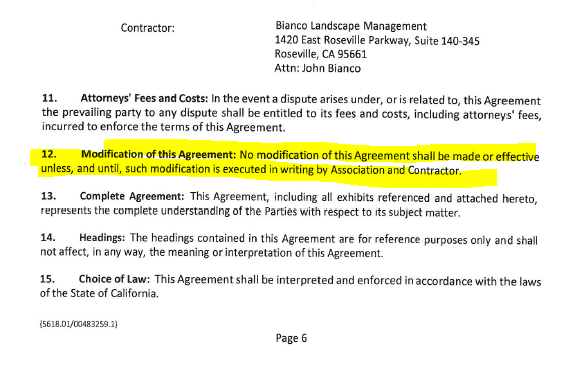
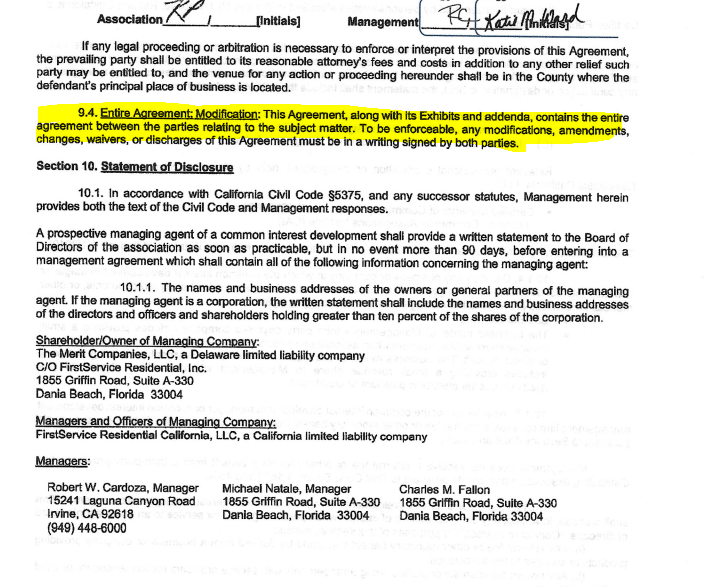
The FirstService Residential agreement expressly requires modifications, amendments, changes, waivers, or discharges to be in a writing signed by both parties. In April 2025, when the Association and FSR changed their existing financial arrangement, they followed that process: they executed a written Amendment changing the base management fee, replacing the reimbursable-services structure, and adding onsite staffing through Addendum C.
Addendum C does allow onsite-staffing expenses to change without necessarily requiring another amendment. But it does not simply make any budgeted amount self-authorizing. Staffing is tied to the Board-approved budget and an agreed staffing plan, and the addendum establishes specific provisions governing staffing costs, compensation changes, employer burden, and Board approval.
The Bianco agreement is more direct. It establishes annual base compensation of $715,452. Although the agreement automatically renews for successive one-year terms, it contains no apparent automatic price escalator increasing that base compensation upon renewal. Instead, it states that additions or deductions to the contract price may be authorized through a written change order signed by the parties and separately provides that no modification of the agreement is effective unless executed in writing by the Association and contractor.
Bianco may also perform certain separately authorized work outside its base maintenance obligations. Those provisions can explain additional charges for particular work; they do not, on their face, convert approval of a higher annual budget into an automatic increase in the underlying base contract price.
The Board unquestionably has authority to approve an annual budget. But approving money to pay an expense and modifying the contractual amount owed to a vendor are not necessarily the same act.
If a higher 2026 amount is authorized by an existing contractual provision—such as FSR’s variable staffing provisions or Bianco’s separately approved extra work—the Association should be able to identify that provision and the records showing its requirements were satisfied.
If instead a vendor’s fixed rate or base compensation increased, the question is different: what contractual provision allowed that rate to change without the written modification otherwise required by the agreement?
FirstService Residential has confirmed that no additional amendments exist for either contract and that the April 2025 documents remain the current agreements, while pointing to the Board’s approval of the 2026 budget as documentation of the 2026 vendor rates.
That response establishes that the budget was approved. It does not establish that budget approval, standing alone, amended either contract.
FirstService Residential says there are no later amendments
On January 12, 2026, FirstService Residential stated in writing:
“There are no additional amendments to either the Bianco or FirstService Residential contracts. The versions previously provided to you via email in April 2025 remain the most current and active agreements.”
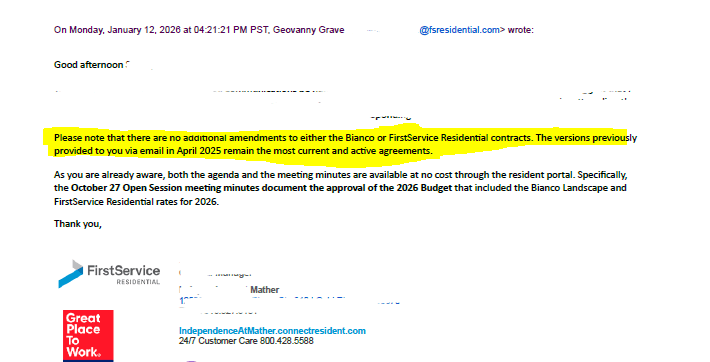
The same email pointed to the October 27 open-session minutes as documentation that the Board approved the 2026 budget, including the Bianco and FirstService Residential rates for 2026.
The minutes do confirm that the Board “approves the 2026 budget as presented.” But they contain another important statement: the budget was based on average actual spending and “expected contract and insurance increases.”
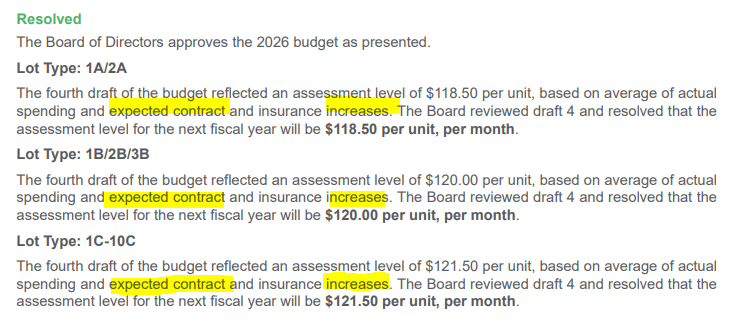
That makes the distinction between budget approval and contract authorization particularly important.
The minutes establish that the Board approved a financial plan anticipating contract increases. They do not identify which vendor contracts were expected to increase, the amount attributable to any particular vendor, whether the increase resulted from a contractual rate change, additional services, variable costs already permitted by an existing agreement, or what contractual provision supported the higher amount.
An expected increase does not necessarily require a new amendment. An existing contract may already permit certain costs to change—as Addendum C potentially does for FSR staffing. But if an increase reflects a change to a fixed contractual rate, scope of services, or other term that the existing agreement does not already permit to vary, the agreement’s written-modification requirements become relevant.
So the question is not whether the Board approved a budget containing expected contract increases. The minutes establish that it did. The question is what contractual authority supported those increases.
If the existing agreements already authorized them, the applicable provisions and supporting records should explain them. If the contractual terms themselves changed, the corresponding written modification should exist.
Why this is more than a technicality
Homeowners are required to fund the Association through their assessments. In return, they should be able to determine how those funds are being spent and what contractual authority supports those expenditures.
This does not require allegations of fraud, theft, or wrongdoing.
It requires basic contract administration.
What the 2026 budget shows
FirstService Residential
The 2026 budget provides:
| FSR category | 2026 monthly budget | 2026 annual budget |
|---|---|---|
| Contract management | $4,500 | $54,000 |
| Management reimbursable | $1,500 | $18,000 |
| Onsite staff | $10,080 | $120,960 |
| Total | $16,080 | $192,960 |
The $4,500 management fee and $1,500 reimbursable-services charge correspond to the fixed amounts established by the April 2025 Amendment. The $10,080 monthly onsite-staffing allocation is different because Addendum C provides a mechanism for staffing costs to change.
Addendum C does not simply authorize any staffing amount placed in an annual budget. It ties onsite staffing to both a Board-approved budget and a staffing plan agreed to by the parties. It also defines the employment-related costs chargeable to the Association, establishes a 12% Employer Cost Burden Rate and conditions for changing that rate, and contemplates potential performance-based salary increases with appropriate Board approval.
The 2026 pro forma also provides useful context. Under the prior budget structure, $15,116 per month was allocated to Contract Management and $239 to Management Reimbursable, for a combined $15,355 per month. The 2026 budget restructures the FSR-related expenses into $4,500 for Contract Management, $1,500 for Management Reimbursable, and $10,080 for Onsite Staff—a combined $16,080 per month.
On a combined basis, the identified FSR-related budget lines increase from $15,355 per month under the prior budget structure to $16,080 per month for 2026—a difference of $725 per month, or $8,700 annually (approximately 4.72%).
The timing and terms of the April 2025 Amendment provide a plausible explanation for much of this restructuring: the amendment changed the management and reimbursable-services structure and added onsite staffing through Addendum C. What the budget does not identify is what accounts for the remaining increase.
Was it increased staffing compensation, hours or staffing levels? Increased benefits or other employment costs? A change in the Employer Cost Burden Rate? Or some combination? If none of the variables permitted by Addendum C accounts for the additional amount, the question becomes whether some other aspect of FSR’s compensation or services changed.
If the additional amount results entirely from variables already authorized by Addendum C, the staffing plan and supporting calculations should demonstrate that. If it instead reflects a change to a fixed contractual rate, services, or other contractual obligations, the agreement’s written-modification requirements become relevant.
A separate cost question: election printing and mailing
The FSR agreement raises another financial question unrelated to the 2026 rate comparison.
The April 2025 Amendment replaced certain individually billed reimbursable expenses with a $1,500 monthly flat charge. Services included in that flat fee include black-and-white and color copying, postage, and expressly, postage for ballot mailing.
The Association also separately paid its Inspector of Elections for election-related services that included printing and mailing ballots.
That does not necessarily mean either payment was unauthorized. The FSR amendment does not specifically state “ballot printing,” and the Inspector of Elections may provide election services beyond the copying and postage included in FSR’s agreement.
It does, however, raise a basic cost-control question:
If the Association is already paying FSR a flat monthly fee that includes copying and ballot-mailing postage, why is the Association separately paying another vendor for those same or overlapping services?
And, if the Association chooses not to use services included in FSR’s flat fee, another question follows: does the contract provide any credit or adjustment for those unused services, or is the Association paying the full flat fee regardless?
If no credit is available, the issue may not be whether the payment violates the FSR agreement at all. It may instead be whether the Association is spending homeowner funds efficiently by purchasing services from a second vendor that are already included, at least in part, in a fee the Association is contractually paying FSR.
The relevant invoices should make the comparison straightforward: what did the Inspector of Elections separately charge for ballot production and mailing, which portions of those services were already encompassed by FSR’s flat fee, and could those additional costs have been avoided?
Bianco Landscape Management
Bianco’s contract sets base compensation at $59,621 per month, or $715,452 annually. The 2026 budget lists $64,310 per month, or $771,720 annually, for front-yard landscape maintenance.
That is a difference of $4,689 per month, or $56,268 per year—7.86% above the stated base contract amount.
That difference does not establish that Bianco was improperly paid. The contract permits certain separately approved work outside the base price, including some irrigation repairs, plant replacement, and other work authorized through work orders or change orders.
But the contract also provides a process for changing the contract price. So the question is not simply whether the budget contains a higher number.
If the difference is fully explained by approved extras, the records should show that. If it reflects a change to Bianco’s base compensation, the contract’s written-change requirements become directly relevant.
If amounts paid to Bianco exceeded the base contract price, what contractual provision, change order, work order, or other written authorization supports the additional charges?
In both cases, the issue is the same, but the contracts and numbers are different: the budget shows what the Association planned to spend, while the operative vendor agreement determines what the Association was authorized to pay and under what conditions.
Budget authority and contract authority are different questions
California Civil Code § 5300 requires common-interest developments to distribute annual budget information and related disclosures. The annual budget is therefore an important part of the Association’s financial governance.
But approving an annual budget does not necessarily answer a separate contractual question.
Consider the distinction:
| Question | What the available documents show |
|---|---|
| Did the Board approve the 2026 budget? | Yes, according to the records provided. |
| Did that budget contain FirstService Residential and Bianco expenses? | Yes. |
| Does the FirstService Residential agreement contain requirements governing contract modifications? | The agreement and April 2025 amendment indicate that changes are subject to written-modification requirements. |
| Was another FirstService Residential amendment executed for 2026? | FirstService Residential stated that no additional amendment exists. |
| Was another Bianco amendment executed for 2026? | FirstService Residential likewise stated that no additional amendment exists. |
| Does approving a budget number itself satisfy the contract’s requirements for changing a vendor rate? | That is the question the underlying contracts and records must answer. |
That last question should not be controversial.
It is exactly the kind of routine oversight an HOA board should be able to answer with documentation.
The records that would answer it
There is no need to speculate about whether a payment was authorized. The Association’s own records should provide the answer.
For FirstService Residential, that means comparing actual payments against the original management agreement, the April 2025 Amendment, the staffing addendum, the agreed staffing plan, and any other operative contractual documents.
For Bianco, that means reviewing the complete executed contract together with every amendment, renewal, addendum, change order, or other document affecting compensation.
The relevant records include:
- The complete, fully executed Bianco contract and all amendments, renewals, addenda, change orders, and work orders;
- The complete FSR management agreement and all amendments and addenda;
- The staffing plan referenced in Addendum C, including the plan applicable in 2025, the plan applicable in 2026, and any revisions between them;
- Records supporting the $10,080 monthly onsite-staffing calculation, including applicable staffing levels, hours, compensation, benefits, and other employment costs;
- Any Board approval of an onsite-staff compensation increase under Addendum C;
- Any notice changing the 12% Employer Cost Burden Rate;
- 2026 FSR and Bianco invoices and payment records;
- Board resolutions or minutes concerning vendor pricing, staffing, or compensation changes;
- The October 27, 2025 agenda and approved minutes;
- and Records showing how the vendor figures included in the 2026 budget were calculated.
Once those records are compared, the question becomes relatively simple:
Was each payment made pursuant to an existing contractual provision, or was a contractual modification required?
What this does—and does not—establish
The available records do not, standing alone, establish that the 2026 assessments are invalid.
They do not establish that every vendor payment was unauthorized.
They do not establish fraud, misappropriation, or intentional misconduct by the Board, management, or any vendor.
What they establish is considerably simpler:
The Association approved vendor-related amounts in its 2026 budget, while FirstService Residential has stated that no additional amendments to the FirstService Residential or Bianco contracts exist.
Where the operative contract permits the amount being paid, there is no inconsistency.
Where the amount being paid requires a contractual modification, the Association should be able to identify the document or contractual provision authorizing that modification.
That is not an accusation.
It is basic financial oversight.
The bottom line
The question homeowners should be asking is not:
“Did the Board approve the 2026 budget?”
We already know that it did.
The better question is:
For every vendor rate paid with homeowner assessments, what provision of the operative contract authorizes that rate—and, where the contract requires changes to be made through a signed writing, where is that writing?
If the existing contract already authorizes the payment, the records should show it.
If a written amendment was required, the amendment should exist.
And if the Association believes that approval of the annual budget itself changed an otherwise binding contractual rate, homeowners are entitled to ask what contractual provision makes the budget vote sufficient to accomplish that change.
That is the value of transparency: homeowners do not have to speculate about where their money is going or whether a payment was properly authorized.
The documents should answer the question.
This post discusses questions raised by Association records and contract language for informational purposes. It does not allege fraud, theft, misappropriation, or other unlawful conduct by any person or entity, and it does not constitute a legal opinion regarding the validity of any assessment or payment. Conclusions should be based on the complete executed contracts, amendments, invoices, payment records, governing documents, meeting records, and applicable law.


Leave a comment